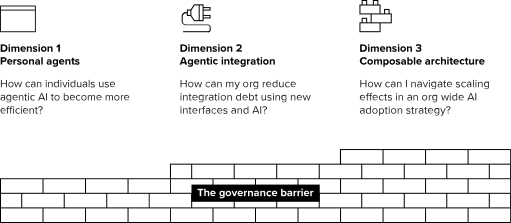
The second dimension addresses a legacy problem that has plagued enterprises for decades: Integration Debt.
Siloed data and rigid API contracts often paralyse cross-functional automation. Fifteen years ago, the industry attempted to solve this with Robotic Process Automation (RPA). The premise was to bypass IT bottlenecks by automating the User Interface.
RPA worked for a time, but it was structurally brittle. It relied on screen coordinates and DOM elements. When the UI changed, the automation broke, leading to escalating maintenance costs that eroded ROI.
MCP functions as a structural evolution of RPA.
It shares the same aggressive integration strategy – bypassing the need for complex middleware projects – but replaces the method. Instead of automating Pixels (which are fragile), MCP automates Capabilities (APIs and UI functions).
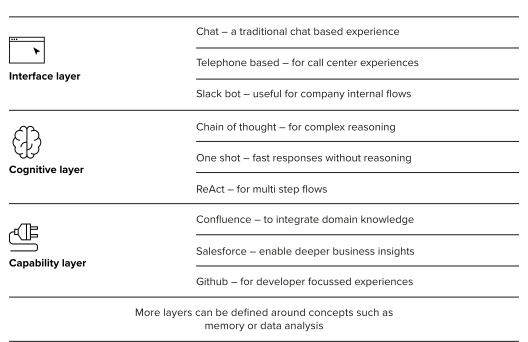
It’s important to clarify that MCP is not “agentic” by default. MCP is simply an interface layer – it exposes capabilities. Whether you attach a deterministic script, a conversational assistant, or a fully autonomous agent on top of those capabilities is a separate architectural choice. In this article, I focus specifically on agentic MCP systems because they highlight the governance issues most organisations will face.
Again, this perspective exists independently. Some organizations will adopt Dimension 2 to address a single high-value operational bottleneck – without ever deploying personal assistants or investing in composable agent architectures.
We are seeing a trend where IT departments use MCP – much like internal API gateways – to streamline the politics of integration. By requiring departments to expose standard MCP servers, organisations bypass the need for bespoke, point-to-point integration projects.